Many wholesalers start their online store the same way: install a retail theme, add products, and give trade customers a discount code. It works for a few weeks. Then a distributor sees a retailer’s price, a buyer asks to pay on terms, someone needs to order 400 lines from a spreadsheet, and an EU customer asks why VAT was charged on their invoice. That is the real B2B vs B2C ecommerce divide: business buying runs on accounts, negotiated prices and repeat orders, not one-off baskets.
However, the problem isn’t the platform — it’s the assumption that B2B is retail with a lower price. It isn’t. Below, then, are the twelve differences that matter most, and what each one means for your store.
Key takeaways
- B2C optimises for impulse and discovery; B2B optimises for accuracy, speed and repeat purchasing.
- The biggest structural differences are pricing (per customer), access (approved accounts), payment (terms) and tax (exemptions and reverse charge).
- One store can serve both audiences — if customer groups control what each visitor sees.
1. Who the buyer is
B2C: one person, spending their own money, often deciding in minutes.
B2B: a professional buyer spending their employer’s money, accountable for getting it right. They care about specification, availability, delivery dates and price consistency far more than about a homepage banner.
The shift toward self-service is well documented: Gartner’s 2026 buyer survey found that 67% of B2B buyers prefer a rep-free buying experience.
What it means for your store: lead with clarity — specs, pack sizes, stock and lead times — rather than persuasion.
2. Number of people involved
A consumer buys alone. A business purchase can involve a requester, an approver, a budget holder and accounts payable. In larger organisations, those are four different people.
What it means: support multiple users per company with shared order history, and consider approval steps for orders above a threshold. We explain the options in B2B company accounts.
3. Pricing is personal
Retail has one public price, with occasional promotions. In B2B, two customers can legitimately pay different prices for the same SKU because of contract terms, volume commitments or channel (retailer vs distributor).
What it means: you need customer groups and price rules, not coupon codes. Codes leak, expire and are easy to forget at checkout. See customer-specific pricing.
4. Access is often restricted
Anyone can buy from a retail store. Many wholesalers only sell to verified businesses — sometimes only within a territory — to protect retailer relationships and pricing.
What it means: registration with approval, and decisions about whether prices (or entire products) are visible to the public. See registration and approval and when to hide prices.
5. Order size and structure
A retail order might have two or three items. A wholesale order might have forty lines, each in cases of twelve, with a minimum order value.
What it means: quantity inputs that respect pack sizes, minimum and maximum quantities, and a cart that stays usable with fifty lines in it. See minimum order quantity strategy.
6. Repeat purchasing dominates
Retail growth depends heavily on acquiring new customers. B2B growth depends on retention: the same accounts reordering, often on a weekly or monthly cycle.
What it means: make reordering effortless — order history with “order again”, saved lists, and a quick order form where buyers type SKUs and quantities directly.
7. Not every price is fixed
Custom configurations, large volumes or project-based orders often need a quote rather than a list price.
What it means: a request-for-quote flow alongside normal checkout, so buyers can ask for pricing without leaving your site. See request for quote in B2B ecommerce.
8. Payment happens later
Consumers pay at checkout. Businesses usually pay on an invoice, often 30 days after delivery, and expect to reference a purchase order number.
What it means: offer invoice, PO and bank transfer methods — but only to approved accounts — while keeping cards for new or small customers. See Net 30 terms and purchase order payments.
9. Tax depends on the buyer
In retail you charge the applicable rate. In B2B, the buyer’s status changes the tax:
- USA: resellers and some organisations provide exemption or resale certificates, and you don’t collect sales tax on qualifying sales.
- EU: cross-border B2B sales of goods to a buyer with a valid VAT number are generally zero-rated, and the buyer accounts for VAT under the reverse charge.
What it means: per-customer tax handling, certificate storage and VAT number validation. See resale certificates and the EU reverse charge.
10. Shipping is a negotiation
Retail shipping is a flat fee or free above a threshold. B2B shipping can mean pallet freight, customer-arranged collection, account-specific carriers or free delivery for contracted accounts.
What it means: shipping methods that vary by customer group. A retailer might see parcel rates; a distributor might see “use my carrier account” or “collection from warehouse”.
11. Content and SEO serve a different searcher
B2C content chases high-volume consumer searches. B2B searches are lower volume but higher intent: “wholesale nitrile gloves case of 1000”, “MOQ private label”, “distributor pricing”. The searcher is often the person who will place recurring orders.
What it means: detailed product pages with specifications, pack data and accurate product structured data, plus content that answers procurement questions. See B2B ecommerce SEO.
12. Success is measured differently
| Metric | B2C focus | B2B focus |
|---|---|---|
| Conversion | Visitor-to-order rate | Share of each account’s orders placed online |
| Order value | Basket upsells | Lines per order, volume tier reached |
| Retention | Repeat purchase rate | Account reorder frequency and churn |
| Efficiency | Fulfilment cost per order | Manual order-entry time saved; order error rate |
| Cash | Payment success rate | Days sales outstanding on terms customers |
B2B vs B2C ecommerce: can one store do both?
Yes — and for many brands it’s the best option. A “hybrid” store shows retail prices and card checkout to the public, while logged-in trade customers see their own prices, minimums, payment methods and tax treatment. The building blocks are:
- Customer groups (retail, wholesale, distributor) assigned on approval.
- Group-based prices — for example role-based pricing and tiered quantity pricing.
- Group-based rules for order minimums, payment and shipping methods and product visibility.
- Tax handling per customer — VAT numbers and exemptions.
The main risk is leakage: a retail visitor seeing trade prices, or a trade buyer charged retail. Test every group with a dedicated test account before launch, and re-test after every pricing change.
When to keep them separate
Two separate stores can make sense when:
- The retail brand and the wholesale business have different identities or audiences.
- The catalogues barely overlap.
- Your retail customers must never know a trade channel exists (some brands protect retailer relationships this way).
Even then, a shared product database avoids maintaining the same data twice.
Turning a retail WooCommerce store into a B2B one?
Start with our WooCommerce B2B setup guide, or browse the B2B extensions that add each piece separately — so you only install what you actually need.
The same product, two buying journeys
To see how these differences add up, follow one product — a case of commercial-grade paper towels — through both journeys.
The consumer
- Searches “paper towels bulk”, lands on a product page.
- Sees one price, picks a quantity, adds to cart.
- Pays by card or wallet, chooses standard delivery.
- Receives a receipt by email. Done in five minutes.
The facilities buyer at a hotel group
- Logs in to their company account, where the group’s contract price is already applied.
- Opens “Order again” from last month, adjusts quantities for three sites, and adds two extra SKUs by typing their codes into a quick order form.
- The cart enforces case quantities and confirms the order clears the minimum for free pallet delivery.
- Because the order is above the buyer’s own spending limit, it goes to the purchasing manager for approval.
- Once approved, it’s placed against a purchase order number on 30-day terms. No card is involved.
- Tax is calculated according to the group’s exemption status and the delivery address of each site.
- The invoice goes to the accounts payable mailbox — not the buyer — with the PO number printed on it, so it can be matched and paid without queries.
Every step in the second journey depends on a B2B feature a retail store doesn’t have. That’s why the most successful wholesale stores are designed around repeat ordering, account structure and finance processes — not around the homepage.
Where to start if you’re converting a retail store
You don’t need everything at once. In most stores, this order delivers value fastest:
- Customer groups and trade pricing — the reason buyers log in at all. See wholesale pricing strategy for how to set the numbers.
- Registration with approval, so the right people get trade prices.
- Order rules — minimums and pack sizes.
- Payment methods by group — invoice or PO for approved accounts.
- Fast reordering — quick order forms and order history.
- Tax handling for exempt and cross-border customers.
- Company accounts and quotes, once accounts are actively ordering online.
For the bigger picture — market trends, platform choice and a full launch roadmap — read our complete guide to B2B ecommerce.
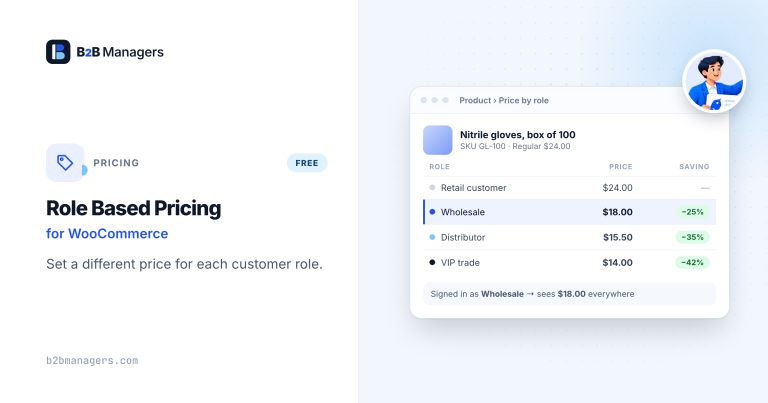
Role Based Pricing for WooCommerce
Different prices for every customer role — percentage or fixed discounts, fixed…
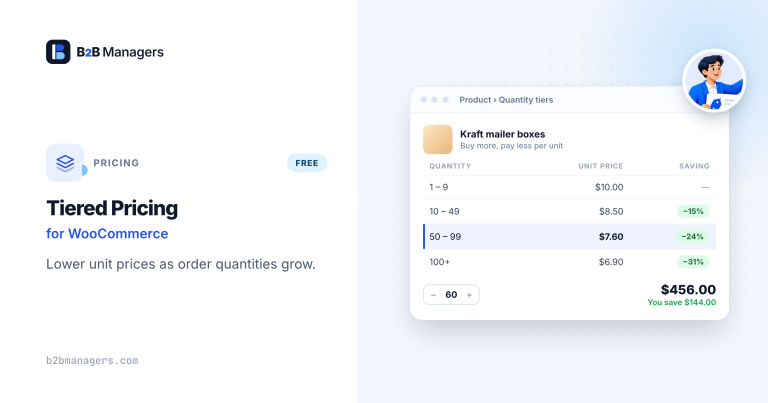
Tiered Pricing for WooCommerce
Quantity-based bulk discounts per product — buy 10+ for 5% off, 50+…
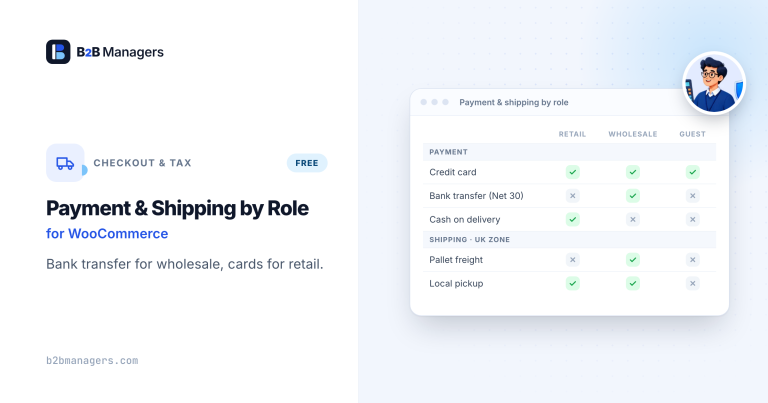
Payment & Shipping Methods by Role for WooCommerce
Show or hide payment gateways and shipping methods per user role —…
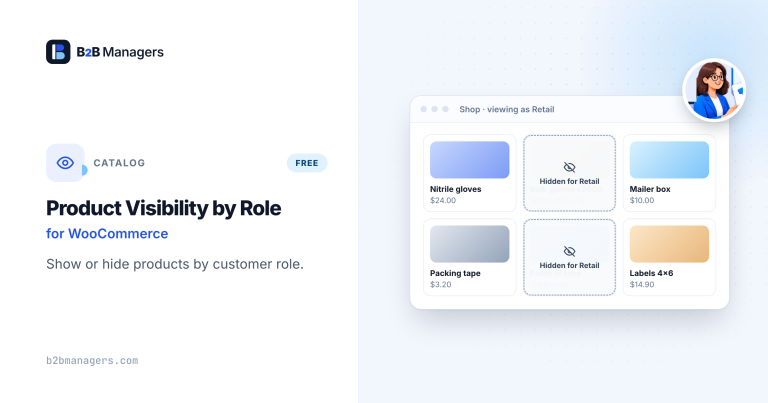
Product Visibility by User Role for WooCommerce
Hide products or whole categories from guests or selected user roles —…
Frequently asked questions
Is B2B ecommerce harder than B2C?
It’s more complex to set up, because pricing, access, payment and tax all depend on who the customer is. Once running, it is often easier to grow, because repeat accounts provide predictable revenue.
Do B2B buyers care about site design?
Yes, but differently. They care about speed, search that finds SKUs, accurate stock and pricing, and fast reordering. A clean, fast store beats a visually elaborate one.
What is B2B2C?
A model where a business sells through another business to end consumers — for example a manufacturer whose products are sold by retailers, but who also supports those retailers’ customers directly. It usually needs both B2B and B2C features.
What is the single biggest difference in B2B vs B2C ecommerce?
Pricing. In B2C everyone sees one price; in B2B each customer may see their own. Most other differences in B2B vs B2C ecommerce, such as accounts, approval, payment terms and tax, follow from the fact that the buyer is a known business with an ongoing relationship.